Car Knowledge
Car controls explained for a complete beginner
Understand the pedals, steering, gears and everyday controls before practising.
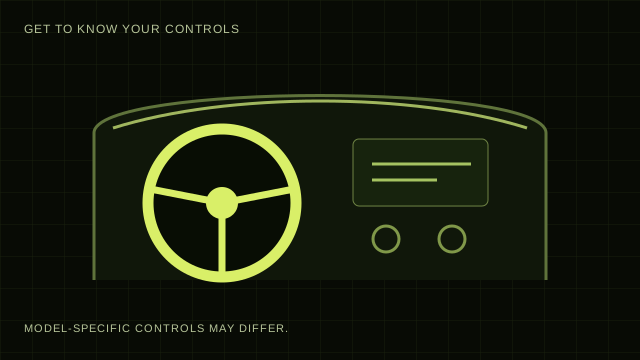
Before learning to drive, learn which control does what. A stationary demonstration lets you ask questions without the pressure of traffic. Controls vary between cars, so identify them in the training vehicle rather than assuming a diagram matches every model. Read the relevant owner’s manual alongside your instructor's explanation.
Pedals and steering
A typical manual car has three pedals: clutch on the left, brake in the middle and accelerator on the right. The clutch temporarily separates engine drive from the transmission so you can select a gear smoothly. Use the left foot for the clutch and the right foot for the brake and accelerator, following your instructor's guidance.
A typical automatic car has a brake and accelerator. Learn the pedal positions before starting; normally the right foot operates both, one at a time. Keep your other foot away from the pedals. The steering wheel changes direction, but the car's response also depends on speed, road grip and how sharply you turn.
Gears and parking brake
Manual gear positions are usually marked on the gear lever. Reverse may require a collar, button or different movement. Practise selecting gears with the engine off and the car secured, under supervision. In an automatic, Park, Reverse, Neutral and Drive serve different purposes; selectors and release buttons differ. Do not experiment while moving.
The parking brake holds a stationary vehicle. Some cars have a hand lever, others an electronic switch or a pedal. Hill hold and automatic parking-brake functions vary. Learn the actual car's procedure, including how to confirm the brake has engaged, before relying on it.
Visibility and information
Find the indicators, headlights, washers, wipers and demister while parked. Identify the speedometer, fuel or charge display and important warning symbols. The horn is for necessary warnings, not expressing frustration. Never let a dashboard touchscreen distract you from the road; set navigation and climate controls before departure where possible.
Practise a simple explanation
Ask yourself: which control slows the car, which holds it when parked and which selects its direction? Explain each answer in your own words. Then identify the controls without looking down for long. Your first moving lesson should concentrate on a small number of tasks at a safe training location. Familiarity with the controls reduces confusion, but it does not replace supervised practice or the required licence conditions.
Sources and review date
Reviewed 12 November 2026. Official requirements can change; check the linked authority before applying or travelling.