
Simulator learning
Simulator Learning: Turning Feedback into Practical Driving Goals
Learn what simulated practice can teach, what its score cannot prove, and how to discuss the next practical lesson with your instructor.
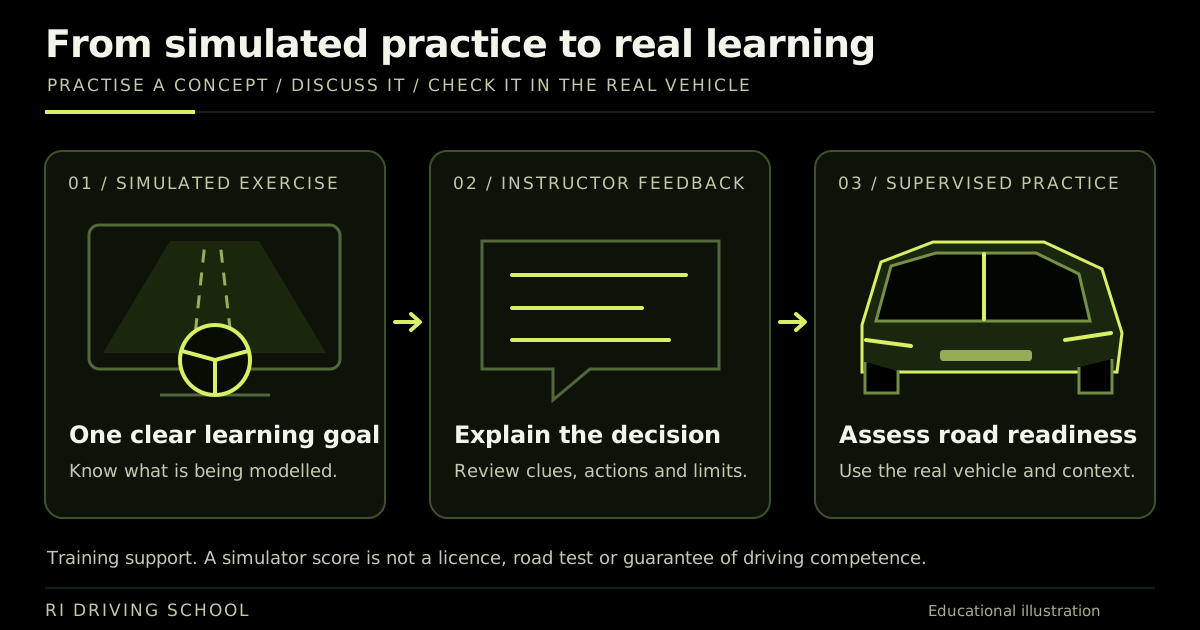
A simulator gives you a setting in which to discuss a driving task, attempt it and review what happened without entering public traffic. Its value depends on the exercise, the equipment and the feedback you receive. A high score does not establish that you can handle a real vehicle safely. Use simulated practice as one part of a learning plan that also includes relevant theory and supervised practical instruction.
Start with a question you can answer
Choose a specific learning question before starting: did you notice the signal early enough, select an appropriate speed, or check the space before changing direction? Trying to improve every skill at once makes feedback difficult to interpret. Tell the instructor what you find confusing and ask which part of the task the exercise can represent. If a feature is not modelled, it cannot be assessed fairly by that exercise.
For example, a signal exercise can help you explain why you should prepare to stop. It cannot prove that your braking pressure will suit a different vehicle, a wet surface or an unexpected situation. Name the concept you practised and the practical skill that still needs checking.
Separate the browser module from the school programme
The website’s interactive practice module uses simplified screen controls and scoring. It is useful for revisiting concepts at home. The school’s Explore current courses is a separate programme. Ask the office about its actual equipment, supported exercises, instructor involvement and available sessions. Do not assume that a browser exercise reproduces the equipment used for your training.
On any unfamiliar simulator, ask how the steering, pedals, gears, view controls and pause function work before beginning. Check your seating and reach. Tell the instructor if the display is uncomfortable or you feel unwell, and stop the session when needed.
Understand what the model leaves out
Simulators vary in the feedback they provide. The equipment may simplify steering resistance, pedal travel, clutch response, road grip, vehicle movement and the view around you. Programmed traffic also cannot represent every uncertain decision made by real road users. A familiar scenario may become easy because you remember its sequence, rather than because your observation has improved.
Research reviewing simulator training has found uncertainty about how consistently improvements carry into real-world driving and safety. That is a reason to check transfer through practical instruction, not to promise a fixed reduction in lessons or an automatic increase in competence. Treat every displayed result as feedback about that exercise.
Review the decision, not just the number
After an attempt, explain what you noticed, what you expected and why you acted. If you missed a hazard, identify the earlier clue you could have used. If the score penalised you, ask which action triggered it and whether the explanation matches the task. An unexplained number is a weak learning record.
A useful note might say: “I noticed the crossing late and focused on the speed display. Next time I will scan farther ahead while maintaining control.” This describes an observation and a next step. It is more informative than writing only “passed” or “failed”.
Move the learning into the actual vehicle
Before a practical lesson, show the instructor one or two points from your simulator notes. While safely parked, compare the real controls, seating, mirrors and dashboard with the simulated arrangement. Consult the relevant owner’s manual where controls or warnings differ. Do not copy a remembered pedal or gear sequence into an unfamiliar vehicle without guidance.
During lawful supervised practice, the instructor can choose a suitable setting and assess whether you apply the concept while managing the vehicle and surrounding traffic. You may need to return to a simpler task. The next exercise should follow observed readiness, rather than the number of virtual attempts completed.
Use repetition without learning a script
Repeat an exercise with a clear improvement goal, then discuss a different example that requires the same reasoning. Changing the scenario can reveal whether you understand the principle. Avoid treating a recorded route, fixed hazard location or remembered signal timing as a substitute for observation. Real conditions do not follow a saved script.
Keep a short record of the exercise, feedback and practical follow-up. Review a related driving-skills lesson or road-sign guide between sessions. This connects the activity to the broader learning sequence without assuming that extra screen time alone makes you road-ready.
Confirm the programme and the legal next step
Before booking, ask what the Simulator includes and how it connects to practical instruction. Confirm the current centre, schedule, session arrangements and total charges with the office. Use the area directory to explain where you will travel from; an area listing does not establish pickup or local equipment availability.
Simulation is a teaching method, not a driving-licence category, a substitute for the applicable driving test, or independent authority to drive on a road. Read the official-source licence guidance and ask the school which lawful practical-learning conditions apply to you. Enquire about simulator learning with these questions ready.
Sources and review date
Reviewed 12 November 2026. The sources below inform the educational principles in this guide. Manufacturer references describe their own equipment; they do not establish which vehicles or systems RI uses. Overseas technical guidance does not determine Indian licensing requirements.
- Driver and Vehicle Standards Agency: training and feedback principles (UK technical reference)
- Journal of Safety Research: systematic review of simulator training
- Maruti Suzuki: use the manual for the correct vehicle model
- Parivahan: Form 2 vehicle classes and driving-licence application
References and review date
Reviewed 12 November 2026. Procedures depend on the actual vehicle and applicable legal requirements.