Parking and Practical Skills
Reversing, parallel parking and bay parking
Use slow movement, all-round observation and a repeatable parking plan.
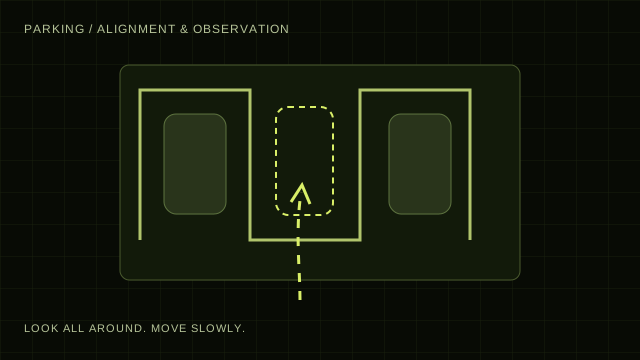
Parking is easiest when you separate it into planning, observation, controlled movement and a final safety check. Different vehicles have different dimensions and turning circles, so a reference point that works in one car may not work in another. Learn in a quiet, appropriate practice area with your instructor before attempting tight public spaces.
Choose a suitable space
Check whether parking is permitted and whether the location would obstruct pedestrians, entrances, visibility or other traffic. Confirm that the space is large enough for the car and that you can leave it safely later. Look for kerbs, bollards, drainage openings and low obstacles that mirrors may not show clearly.
Before reversing, observe around the vehicle, including areas behind and beside it. Use mirrors and a direct view as appropriate. Move slowly enough to stop immediately if the situation changes. Recheck repeatedly; a child, pedestrian or bicycle can enter an area that was clear a moment ago. Stop whenever you lose a useful view.
Parallel parking
Your instructor can demonstrate an approach position and turning sequence suited to the training vehicle. Use gentle steering and low speed, checking the front of the car as it swings out as well as the rear. Do not concentrate only on the kerb. If the angle is wrong, stop and correct safely rather than forcing the manoeuvre.
Bay parking
Choose a bay with enough space and inspect its surroundings. Follow the practice method taught for the vehicle, allowing for adjacent cars and pedestrian routes. Observe both sides while turning and straighten as required. Cameras and sensors are supplementary aids; lens distortion and blind areas can make an object appear farther away or disappear from view.
Finish safely
Once positioned, stop completely, secure the car using the manufacturer's procedure and check that it is within the space. Leave sufficient room for people to pass and for doors to open safely. Before opening a door, look for approaching traffic, especially cyclists and motorcycles. Take valuables and loose items with you where appropriate.
A good practice score should reward observation and careful corrections, not just ending between painted lines. Ask your instructor to explain what went well and choose one point to improve next time. A slow, safe correction is a successful learning decision, not a failure.