Traffic Signs
Road signs, traffic signals and markings: a beginner guide
Recognise common sign families and connect them to safe decisions.
Road signs give you information before you reach a decision point. Learn both the appearance and the action each sign requires. A quiz can help recognition, but the real skill is noticing a sign early enough to respond safely while continuing to observe other traffic.
Recognise the sign families
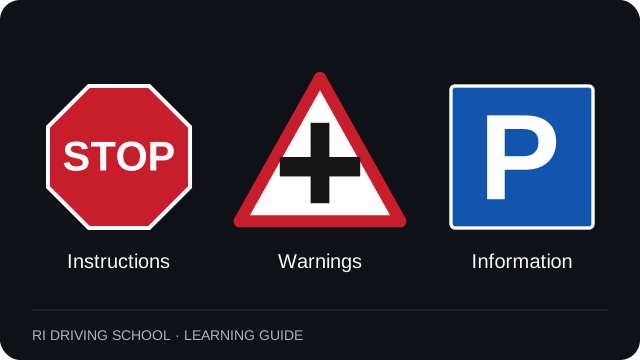
Regulatory signs tell you about a restriction or requirement. Many are circular, but important exceptions include the octagonal Stop sign and inverted-triangle Give Way sign. Warning signs commonly use a red-bordered triangle to alert you to a hazard ahead. Information signs help with directions, destinations and services. Use the official Assam Transport sign reference to study the actual symbols.
Do not identify a sign by colour alone. Read its symbol, number, arrow and any supplementary plate. A restriction may apply to a particular direction, vehicle or time. Temporary signs around works can change the usual arrangement. If a sign is obscured, slow down and look for other lawful guidance without making a sudden manoeuvre.
Respond to traffic signals
Stop at a red signal before the applicable stop line. A steady amber calls for stopping unless you are so close that stopping safely is no longer possible; it is not an invitation to accelerate. Proceed on green only when your way is clear. Follow the directions of an authorised traffic officer where they override the signal arrangement.
Read the road surface
Lane lines organise movement. Stop lines, crossing markings, arrows and areas reserved for particular traffic tell you where to position and where to wait. Different line patterns have different meanings, so learn them from current official guidance and your instructor. A broken line does not mean a manoeuvre is automatically safe; observation and a suitable gap still matter.
Keep pedestrian crossings and junction exits clear. Never use a painted area or footpath as extra parking simply because other drivers do. Worn markings make early observation and cautious judgement more important, particularly at night and in rain.
Make revision practical
Study a small group of signs, explain the required action in your own words and then identify examples during an instructor-led lesson. Ask what might happen if you noticed the sign late. Repeat any quiz questions you miss and read the explanation. This resource supports learning; official rules and the signs applying to the actual road remain the authority for your decision.
Sources and review date
Reviewed 12 November 2026. Official requirements can change; check the linked authority before applying or travelling.