
HMV Driver Training Course
Heavy Vehicles: Visibility, Turning Space and Safe Planning
Learn why observing around a heavy vehicle and planning its complete movement matter, without relying on fixed blind-spot distances or steering formulas.
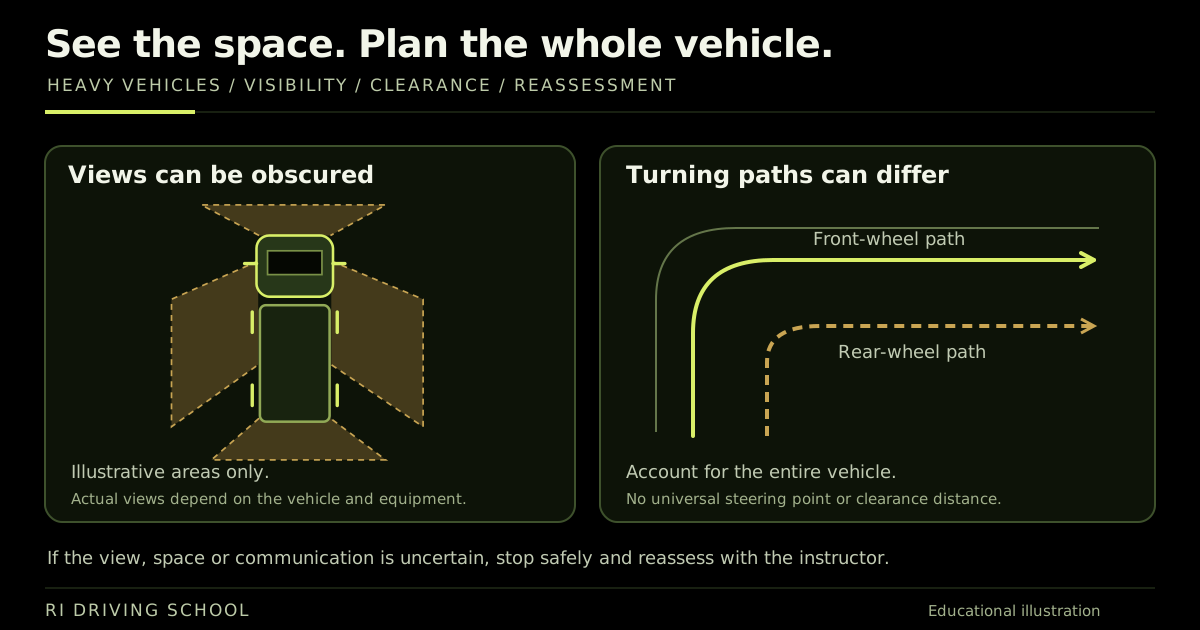
A heavy vehicle occupies more road space than a car, and the driver may not see everything close to it. Safe planning therefore needs attention to people, the whole vehicle and the space into which it will move. This guide explains questions to discuss during supervised training. It is not a steering formula or permission to practise in public traffic without the correct entitlement and supervision.
Learn the particular vehicle before discussing a manoeuvre
A heavy goods vehicle and a heavy passenger vehicle do not have identical layouts or purposes. Length, wheelbase, body shape, mirrors, cameras and any trailer affect what the driver must consider. Ask which actual class and vehicle your training covers, rather than treating “HMV Driver Training Course” as a precise description of every heavy vehicle.
With the vehicle safely stationary and secured, ask the instructor to explain the driving position, observation equipment, relevant dimensions and control systems. Identify the correct manufacturer’s guidance. Familiarity with a smaller vehicle does not establish that you understand this vehicle’s visibility or its movement through a turn.
Visibility is a changing picture
An area not visible directly may be covered partly by a mirror or camera, but equipment has limits. Dirt, damage, adjustment, glare, weather and the position of a person can affect the information available. A person can also move between views while the driver checks another direction. Do not interpret one apparently clear image as a permanent guarantee that the surrounding space is empty.
Volvo Trucks’ accident research describes serious conflicts involving limited visibility and divided attention around pedestrians and cyclists. Its findings support a careful discussion about observation, but they do not establish the equipment fitted to an RI training vehicle or the exact blind areas around it.
Ask for a safe stationary visibility demonstration
An instructor can organise an appropriate demonstration with the vehicle secured, controlled access and clear communication. The purpose is to compare what is visible from the driving position with the positions around the vehicle. Learners should not place themselves around a running vehicle or organise a blind-spot experiment beside live traffic.
Record which views need adjustment or further explanation. Ask what the mirrors or camera do not show and how the picture changes with the vehicle’s configuration. A coloured diagram is only a concept illustration: it is not a measured map of safe and unsafe positions for every truck or bus.
Plan for the entire vehicle, not only the cab
During a turn, different parts of a long vehicle can follow different paths. Rear wheels may track inside the path of the front wheels, while body overhang or a trailer creates other clearance concerns. The required space depends on the actual vehicle and manoeuvre. There is no universal curb distance or steering point that makes every turn safe.
Ask the instructor to explain the full movement in a suitable training setting. Discuss what could be beside the vehicle, where the rear section will travel and whether the exit remains clear. Do not use a diagram as instructions to swing across a lane or enter space you cannot assess safely.
Account for people who may misunderstand the movement
A pedestrian or rider may see the vehicle but misread its intended direction. A cyclist approaching a junction may concentrate on a signal and not recognise the vehicle’s turning needs. An indicator communicates an intention; it does not establish that someone has noticed or will respond as expected.
Before and during a supervised manoeuvre, discuss how the driver keeps updating the view and recognises uncertainty. If a person’s position or the available space cannot be established, the priority is to avoid continuing into that uncertainty. Follow the instructor’s safe stopping and reassessment guidance for the actual situation.
Choose the setting and assistance carefully
Delivery entrances, depots and bus stopping areas can combine pedestrians, parked vehicles, loading activity and limited space. Plan access before committing the vehicle to a confined area. Ask about suitable routes, restrictions, overhead clearance and any local site procedures. A navigation instruction does not verify clearance or legal access.
Where competent assistance is used, agree the communication method and safe positions before movement. If communication is lost or instructions become unclear, stop and resolve the problem. Do not ask an untrained bystander to stand in a crush zone or use an improvised hand signal as a substitute for a proper plan.
Treat safety systems as information, not permission
Warnings, cameras and other assistance features can support observation, but their operating conditions and limitations must be understood from the vehicle’s instructions. Do not assume that silence from a warning system means no person is present. Ask what the system detects, what can obstruct it and how a fault is reported.
A pre-journey routine should include the relevant visibility equipment, tyres, lights, controls and warning indications. Report suspected safety defects before taking charge. Specialist checks and repairs belong with competent personnel. Review related road-safety guidance without treating a general checklist as the manufacturer’s complete procedure.
Make your learning goals concrete
After a lesson, describe the decision you understood better: identifying an obscured area, recognising a clearance concern or choosing to stop and reassess. Ask what still requires prompting and which exercise should follow. Avoid measuring progress only by how tight a space you negotiated or how quickly you completed a route.
For the HMV Driver Training Course, confirm the actual goods or passenger class, vehicle, centre, eligibility, training scope, schedule and charges with RI. Use the area directory to explain your location, then enquire about the appropriate training. No photograph, course label or completion record establishes government accreditation or replaces the relevant licensing requirements.
Sources and review date
Reviewed 12 November 2026. The sources below inform the educational principles in this guide. Manufacturer references describe their own equipment; they do not establish which vehicles or systems RI uses. Overseas technical guidance does not determine Indian licensing requirements.
- Volvo Trucks: safety research into heavy-vehicle collisions
- Volvo Trucks: passenger-side visibility and turning conflicts
- Driver and Vehicle Standards Agency: vehicle checks (UK technical reference)
References and review date
Reviewed 12 November 2026. Procedures depend on the actual vehicle and applicable legal requirements.