
Car driving
Your First Car Lessons: A Practical Learning Sequence
A clear progression from understanding the parked car to making calm decisions in traffic, with practical questions for each lesson.
Learning to drive becomes easier to organise when each lesson has a clear purpose. A useful first goal is not a busy route or a particular number of kilometres. It is being able to explain what you are doing, observe the space around the car and control the vehicle without rushing. Use this sequence to discuss a lesson plan with an instructor; it is not a promise that everyone will progress at the same pace.
Start with the person, the paperwork and the car
Tell your instructor about previous experience, any difficulty reaching or operating controls, and situations you find confusing. Before public-road practice, confirm the licence entitlement, learner conditions and supervision that apply. Do not assume a booking itself gives permission to drive. Ask where to meet and which vehicle and transmission will be used, because those arrangements have to be confirmed separately.
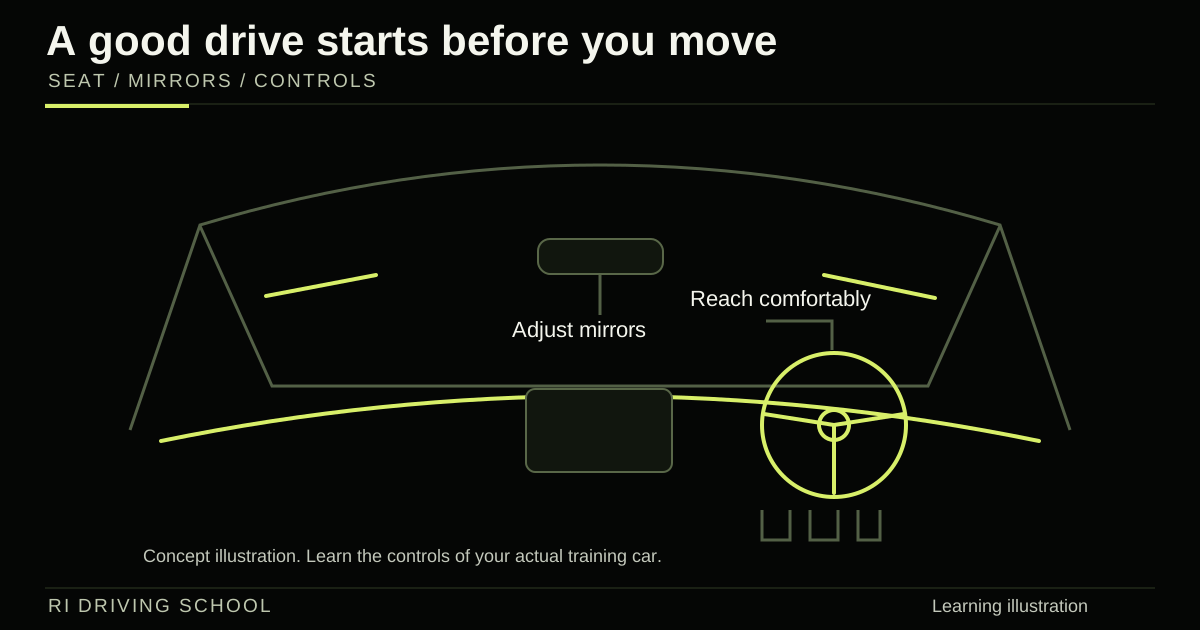
While safely parked, adjust the seat so you can operate the pedals properly without stretching. Set the backrest, head restraint and mirrors, then fasten the seat belt. Locate the indicators, wipers, lights, demister and parking brake before moving. Your instructor and the vehicle's manual should explain model-specific controls and warning lights.
Build control before adding complexity
Practise moving away and coming to a controlled stop in an appropriate setting chosen by the instructor. In a manual car, clutch coordination is part of that task. In an automatic, understand the selector positions and the way that particular vehicle moves at low speed. Neither transmission removes the need for careful observation, speed control and a clear stopping plan.
Keep the first exercises simple enough to notice cause and effect. For example, after a stop, discuss whether the slowing began early enough and whether the final movement felt controlled. If several tasks become confusing at once, ask to repeat one part. A calm repetition teaches more than completing a difficult route without understanding it.
Add observation to every change
Looking ahead and checking mirrors are ongoing activities, not a ceremony completed at the start. Before changing speed or position, consider who could be affected. A mirror does not show every area, so learn the appropriate direct observations for moving off, changing lanes and reversing. An indicator communicates an intention; it does not reserve a space.
- Identify the next place where someone might enter your path.
- Notice what is happening behind and alongside before changing position.
- Choose a speed that leaves time to understand the situation.
- If the view or space is inadequate, wait rather than guessing.
Practise one road situation at a time
When basic control becomes more consistent, discuss a suitable sequence of turns, crossings and junctions. A quiet junction and a crowded junction may require the same underlying observations but impose very different demands. The instructor should choose conditions suited to your current ability and lawful training arrangements, rather than treating a well-known road as a compulsory route.
Describe the reason for a decision when the instructor asks: a pedestrian approaching a crossing, a vehicle obscuring your view, or a narrowing gap. This develops judgement alongside steering. It also helps distinguish an observation mistake from a control mistake, so the next exercise addresses the actual difficulty.
Keep a short lesson record
After each lesson, write three things: what you practised, what improved and what still needs help. Replace vague entries such as “bad at junctions” with a specific observation such as “I looked too late before changing position.” Agree on one or two goals for the next session. Avoid comparing your progress with another learner's advertised completion time.
A useful review also includes what you could do without prompting and when the instructor had to intervene. Progress is stronger when a skill remains reliable on another day or in a slightly different setting, not just immediately after a demonstration.
Questions to ask before the next lesson
Ask how practical time is counted, how cancellations are handled, how progress is recorded and when more demanding conditions may be introduced. Confirm the actual centre, available schedule and total agreed course scope. Explore the Car driving courses information or send your questions to RI Driving School. For a focused next skill, read our parking-practice guide.
Further reference: the official copy of the Motor Vehicles (Driving) Regulations, 2017 explains road duties. Use the exact vehicle manual, such as the relevant model in Maruti Suzuki's manual library, for its controls. This reference does not identify RI's training vehicles.
Choose your Guwahati area when making an enquiry. The office will confirm the actual serving centre and availability; the directory does not imply a branch in each locality.
References and review date
Reviewed 12 November 2026. Check the official source for current requirements.