Motorcycle Riding Training Course
Bike or scooty training: choose the right vehicle class
Compare MCWG motorcycle training and MCWOG scooty training. Understand controls, learning goals, licence checks and how to choose a suitable course.
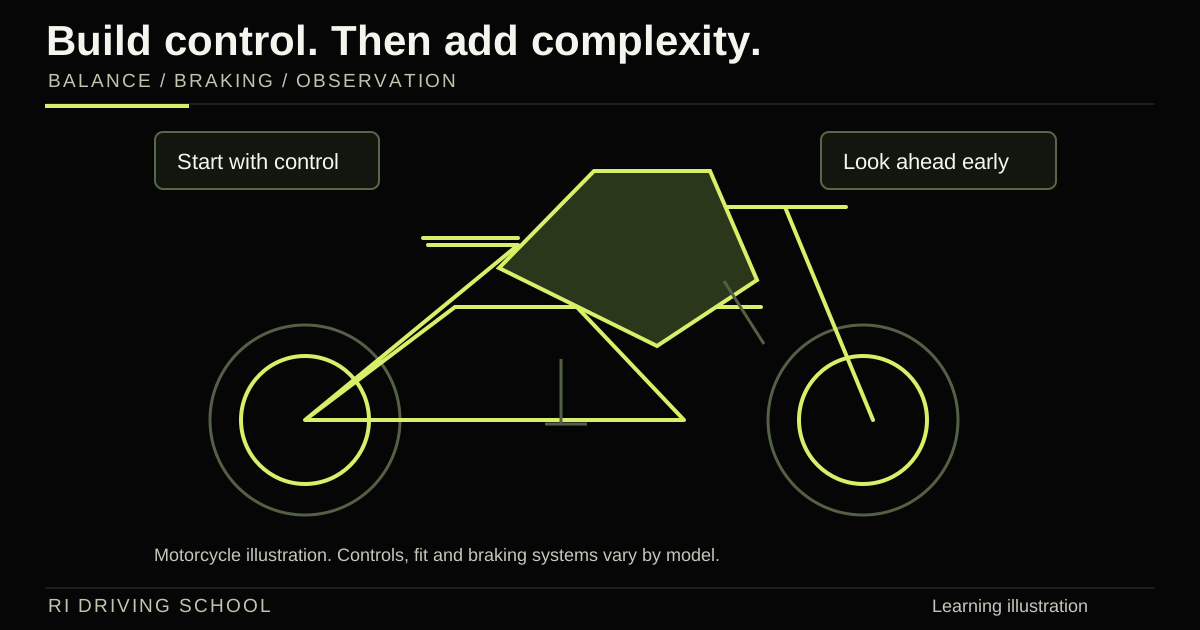
Bike and scooty lessons share balance, observation and safe decision-making, but their controls and licence categories can differ. Choose the vehicle you actually intend to learn rather than treating all two-wheelers as the same course.
Understand MCWG and MCWOG
MCWG means Motorcycle With Gear. RI’s Motorcycle Riding Training Course covers the applicable geared motorcycle training, including coordination of clutch, gears, throttle and brakes. MCWOG means Motorcycle Without Gear and includes the applicable scooty or scooter course. Staff should confirm the actual model, controls and vehicle class before admission.
The course name, the class you are learning and the class already recorded on an existing licence are separate fields. A student who holds a car licence should not assume it also covers a motorcycle. The licensing authority must confirm the entitlement applicable to the actual vehicle.
What both courses need to build
Early lessons should establish a stable riding position, understanding of the controls and controlled starting and stopping in a suitable setting. Your trainer then assesses readiness for more complex exercises. Protective equipment, observation, speed choice and appropriate space around other road users remain important throughout.
Tell the trainer about previous experience honestly. Familiarity with a bicycle or another two-wheeler can be useful background, but it does not prove that you can safely control the proposed vehicle. Ask for the exercise to be explained again when a control or instruction is unclear.
What geared motorcycle practice adds
With a geared motorcycle, the learner needs to coordinate the clutch and gear selection with the throttle and brakes. The aim is controlled movement and deliberate changes of speed, while keeping attention available for the surroundings. Practise according to the actual motorcycle’s controls and the trainer’s instructions.
Read the motorcycle control practice guide for a useful sequence to discuss with your trainer. It is preparation for supervised learning, not a substitute for it.
What scooty practice focuses on
Without manual gear changes, a beginner can focus on the particular vehicle’s throttle response, braking, balance and low-speed control. That does not make observation or traffic judgement optional. Smooth control and a safe stopping routine matter more than rushing into busy traffic.
The first scooty lessons guide explains how to approach the initial controls and stopping exercises with a trainer.
Confirm eligibility and the lesson arrangement
Ask the school to check the applicable age and learner’s or driving-licence requirements for the actual vehicle. Do not assume that the same age rule applies to every two-wheeler or that a vehicle is eligible for an exception simply because it is called a scooty.
Confirm the centre, trainer, training vehicle, session length, fee and timetable. Hatigaon and Machkhowa have separate centre profiles; availability of a specific vehicle or course must be confirmed for your selected centre. If the planned course changes, ask staff to update the saved enrolment before training and document issue.
How to decide
- Identify the vehicle type you plan to ride and its actual licence class.
- Explain your current experience and the controls you need to learn.
- Ask which suitable vehicle and trainer are available at your preferred centre.
- Confirm the practical and theory learning goals, timetable and requirements.
- Review progress with the trainer before moving to more demanding conditions.
Compare the full Motorcycle Riding Training Course and Scooter Riding Training Course, then enquire about the course that matches your needs.
Official references and review date
Checked 13 November 2026. Confirm the requirements for your actual application with the competent authority.